
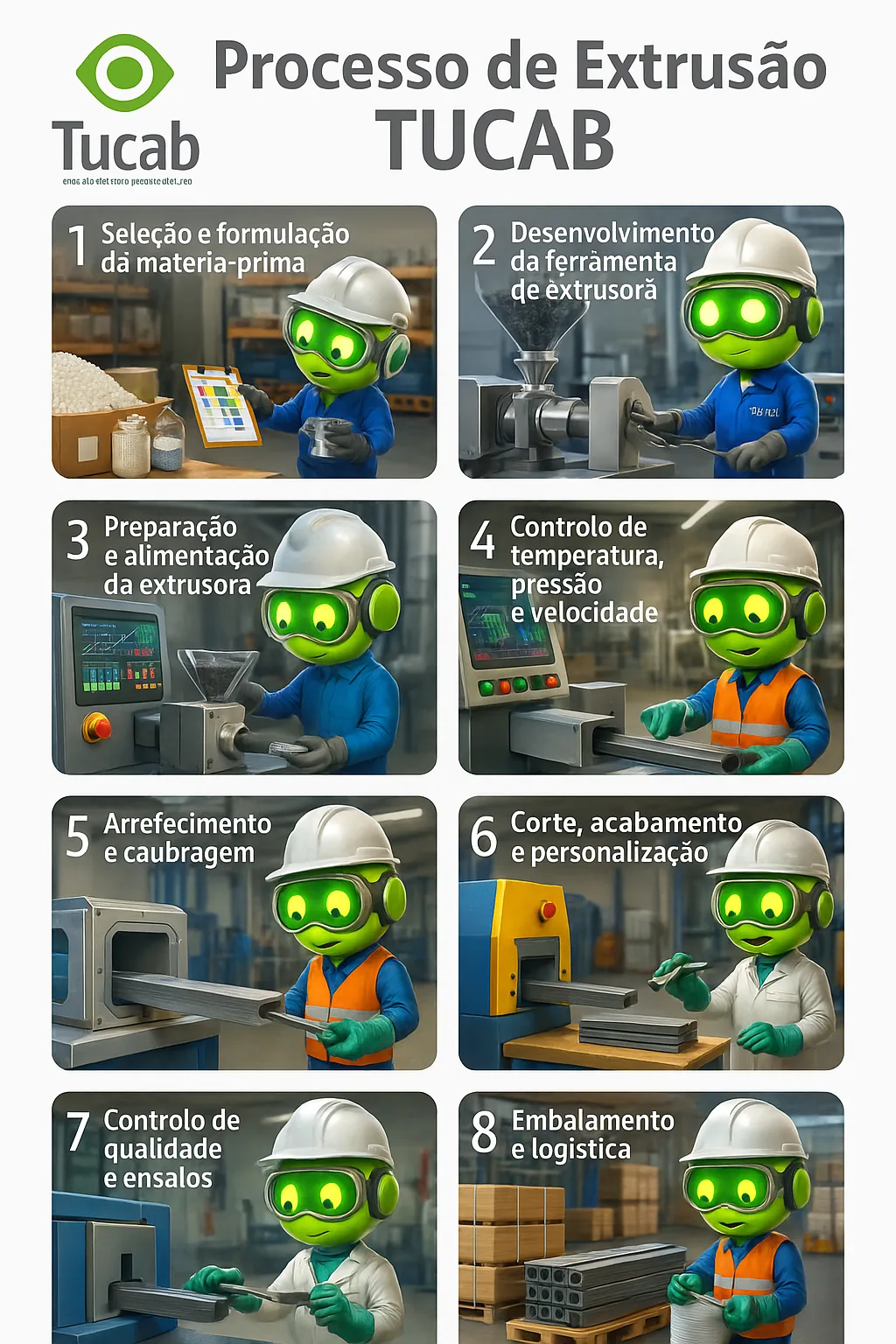
Plastic extrusion is an industrial process that transforms polymeric materials into continuous parts with a defined cross-section, such as tubes, profiles or seals (trimmings). With vast experience since 1996, TUCAB masters all stages of this process, acting as a technical partner for customers in extrusion projects. Over the years, TUCAB has solidified its capacity for innovation and adaptation to the needs of its customers, positioning itself as a complete supplier (end-to-end) in extrusion – from the initial concept to the final product – with quality excellence. Below, we present in a technical and educational way the main steps involved in the production of extruded tubes, profiles and seals, highlighting TUCAB's support at each stage and the commitment to tailor-made solutions for each client.
Raw Material Selection and Formulation
The first step towards a quality product is the choice of the appropriate raw material and its formulation. The most common base materials are thermoplastic polymers – from general purpose polymers such as polyethylene (PE) and polypropylene (PP) to engineering materials such as polycarbonate (PC), as virtually all thermoplastics can be extruded. The selection of the plastic type depends on the requirements of the final product: for example, flexible PVC or thermoplastic rubber (TPE/SEBS) for soft seals, rigid PVC or ABS for structural profiles, or PE/PP for technical pipes. In addition to the base polymer, additives and fillers are incorporated into the formulation to provide the desired properties. These additives may include thermal stabilizers (essential in PVC), plasticizers (to increase flexibility in vinyl compounds), pigments or dyes (to obtain the specified color), anti-UV agents, flame retardants, among others. The appropriate formulation ensures that the extruded plastic material will have the mechanical resistance, durability and finish expected in service.
At TUCAB, this stage is carried out with a strong technical and customer consultancy component. The company's R&D team helps define the best raw material for each application, often developing specific compositions for the project. This multidisciplinary team can adjust everything from the choice of polymer to the dosage of additives, ensuring that the raw material is perfectly adapted to the customer's requirements. For example, TUCAB developed SEBS seals as an alternative to traditional EPDM, obtaining technical and environmental advantages. Another important aspect is sustainability: all plastic waste generated in the production process is always reintroduced into the process in the form of recycled raw material. This circular economy policy reduces waste and reflects TUCAB's environmental concern, without compromising the quality of the final product.
Development of the Extrusion Tool (Die or Milling)
Each new tube or profile requires the development of a specific extrusion tool, generally called die (or die), which will shape the product. The matrix is a precision metal component with an opening designed exactly with the desired cross-sectional geometry. In the case of complex profiles, auxiliary tools such as calipers (calibration sleeves) or even integrated technical cutters may also be necessary to define additional details of the shape. The die design considers the desired dimensions of the finished product, compensating for factors such as material contraction as it cools and the viscous flow of the molten polymer. Small variations or imperfections in the matrix can translate into defects in the extrudate, which is why this development requires specialized know-how. Die construction often involves high-precision workshop processes (e.g. CNC milling), hence the reference to "die or milling cutter".
TUCAB has extensive experience in the design and manufacture of extrusion tools, supporting the customer from the profile design phase to the production of the required equipment. With a dedicated technical team, the company in-house develops matrices and other tools based on the idea or design provided by the client. This integrated approach ensures that the tool is optimized for the selected material and the production line in which it will be used. The result is robust and reliable matrices, capable of producing profiles within the required dimensional tolerances and with an excellent surface finish. By controlling the development of the tool, TUCAB ensures agility in the prototyping phase and the possibility of quick adjustments, offering customized solutions depending on the geometries desired by the customer.
Preparation and Feeding of Raw Material into the Extruder
With the raw material defined and the matrix manufactured, production into the extruder is prepared. The plastic raw material – typically supplied in the form of pellets – is first conditioned. Depending on the material, pre-treatment such as drying (for example, in hygroscopic polymers that absorb moisture, such as nylon or ABS) or mixing in a tumbler to homogenize additives may be necessary. The material is then loaded into the extruder's feed hopper, a hopper that continuously feeds the extruder by gravity.
Inside the extruder, the material passes into the heated cylinder, where it meets a rotating screw. This screw transports the material along the cylinder while gradually compressing and melting it. The extruder barrel is segmented into controlled heating zones, which progressively raise the temperature of the material until it becomes viscous and completely melted. The mechanical action of rotation of the screw also generates heat through friction, helping to plasticize the raw material. When it reaches the end of the cylinder, the polymer is in a homogeneous semi-liquid form. In this position there is usually a filter (metal screen supported by a plate called breaker plate) that retains any impurities and equalizes the flow pressure. The molten material is then forced through the extrusion die under high pressure, instantly adopting the shape of the opening of this diekuhne-mb.de. In short, in this step the solid raw material is converted into a continuous melt and shaped into the desired section, leaving the extruder head with the desired geometry.
Temperature, Pressure and Speed Control Throughout the Process
During extrusion, the stability of processing parameters is essential to obtain a consistent product within specifications. The three main parameters to control are temperature, melt pressure and extrusion speed.
-
Temperature: The temperature of the cylinder and die must be strictly controlled, as it directly influences the viscosity and homogeneity of the melted plastic material. Heating zones throughout the extruder maintain specific temperature profiles – typically increasing from the feed zone to the zone near the die. Precise control ensures that the polymer reaches ideal fluidity without degrading. Modern extrusion systems include sensors and controllers that regulate temperatures in real time, ensuring that the extruded profile reaches the desired mechanical and dimensional properties at the end of the process.
-
Pressure: The material is pushed through the die under high pressure generated by the rotation of the screw. This pressure also needs to be monitored and adjusted as necessary. Pressure that is too low may indicate insufficient flow or risk of the material solidifying before the die; Excessive pressure can overload the machine or cause defects in the extrudate. Pressure gauges and sensors installed in the extruder allow checking and controlling this parameter. The controlled melt pressure determines the flow rate of the material and the quality of molding in the matrix, being a key factor in the flow behavior of the polymer. The exact coordination between temperature and pressure results in stable processing conditions and a high quality final product, without unwanted variations.
-
Speed: Here we consider both the screw rotation speed (which defines the extrusion rate, i.e. how many kg/h of material are extruded) and the traction speed (the pulling of the profile at the exit, carried out by belts or pull rollers). Adjusting the screw speed allows you to control production and avoid excessive efforts (which would cause overpressure) or, conversely, very slow flows (which could cause temperature variations). The traction speed must be synchronized with the output of the material, in order to keep the extrudate without unwanted stretching or loosening while it cools. In short, the overall speed of the process must be constant and appropriate to the material and geometry. Temperature, pressure and speed act together: these parameters play a fundamental role in optimizing the viscosity and fluidity of the melt during extrusion. Modern lines use computerized control systems that continuously monitor these variables (temperature curves, pressure profiles, screw and handle speed), automatically intervening to correct deviations and stabilize production. This rigorous control guarantees consistent product quality, batch after batch, and maximizes the efficiency of the production process. In order for the part to maintain the shape defined by the matrix, it is necessary to immediately subject it to a controlled cooling process, often combined with dimensional calibration. At this stage, the objective is to solidify the polymer in the desired final shape, avoiding deformations.
The most common method of cooling in profile and tube extrusion is through a water bath. The extruder is equipped with a tank immediately after leaving the die, where the profile passes through water at a controlled temperature (generally cold) that quickly removes heat from the plastic. In some cases, water sprayers are also used along cooling troughs, or even forced air cooling tunnels, depending on the material and thickness of the extruded part. Rapid cooling causes the plastic to solidify, permanently fixing the profile shape. It is crucial to calibrate during cooling to ensure that the dimensions are exactly within specification.
Calibration is carried out with the aid of tools called calibration sleeves or calipers, which serve as a template for the newly formed extrudate. For example, in the case of circular tubes, a vacuum calibration is used: the tube passes inside a slightly larger metal sleeve, where applied vacuum causes the tube to expand against the walls of the sleeve, ensuring the correct external diameter and perfect roundness while it hardens. For profiles with complex geometry, calibration tables contain multiple calibrators (metal or low-friction materials) positioned along the length, which hold the profile in the exact shape until it cools completely. In all cases, calipers are precision tools that define the final dimensions of the extruded product after leaving the die. Therefore, cooling and calibration work together: the profile is cooled homogeneously and dimensionally controlled at the same time, in order to avoid uneven contractions, curvatures or other deformations.
It is worth noting that TUCAB employs cooling and calibration processes appropriate to each type of product. With its 14 extrusion lines available, the company produces everything from small diameter flexible tubes to wide flat profiles, adapting the cooling system (bath, spraying, forced air) and the type of calibrator used. Post-extrusion processes such as cooling and calibration are essential to ensure that the extruded product achieves the intended final shape and function, and TUCAB's experience guarantees precise control of these steps, even for demanding geometric profiles.
Cutting, Finishing and Final Customization
Once the extrudate has been formed and solidified upon leaving the calibration line, the cutting and finishing step follows. Because the extrusion process produces a continuous profile (which can be tens or hundreds of meters long as it exits the machine), it is necessary to cut the product to the dimensions specified by the customer. This cutting can be carried out inline, using guillotines or automatic saws synchronized with the extrusion speed, ensuring pieces with uniform lengths (e.g. 3 meter tubes, 2 meter door jamb profiles, etc.). In other cases, the extruded material is wound on coils or rolls (when it comes to flexible hoses or filaments, for example) and subsequently cut. Cutting precision is important to maintain quality and facilitate customer use of the product.
After cutting, special finishes or customizations are often carried out according to the needs of the application. TUCAB has a strong focus on customized solutions, which includes adapting the characteristics of the product after extrusion. Examples of possible final finishes include:
-
Application of adhesive tape: Some extruded profiles used in sealing (such as trim for doors and windows) can receive adhesive tape on one side, allowing easy fixing by the customer at the installation site. TUCAB can incorporate this step, gluing high-adhesion tapes to the profiles according to specification.
-
Gluing or welding: In the case of certain tubes or hollow profiles, it may be necessary to glue covers, additional parts or even the welding of segments (e.g. to form rings). These processes can be carried out in the final stage, ensuring that the product arrives ready for use.
-
Technical cuts or perforations: Extruded profiles may require special cuts along the part (holes, notches, grooves) that are not obtained directly when leaving the die. With CNC cutting equipment or cutting molds, TUCAB can carry out these post-extrusion modifications with precision, taking into account the customer's complex technical drawings.
-
Surface treatments or printing: In some cases, it is also possible to apply additional treatments, such as marking/printing on the product (for example, marking meters on hoses, logos, or instructions) or surface coatings (varnishes, anti-UV treatments, etc.) for extra features. These operations are integrated in-line or performed immediately after extrusion for greater efficiency.
As a whole, the cutting and finishing phase is where the extruded product is customized and finished according to the specific requirements of each customer. TUCAB stands out for offering this customized finish as part of its complete service – which means that the customer receives an extruded product ready to be applied to their assembly line or project, without the need for rework. This commitment to “customized solutions”, from tool development to the final finished product, is one of the pillars of TUCAB's service.
Quality Control and Technical Testing
Maintaining a high quality standard is a priority throughout the entire extrusion process at TUCAB. From the raw materials to the final packaged product, rigorous quality controls are implemented and technical tests are carried out to verify the product's compliance with applicable specifications and standards.
Soon after production (even during and after cutting), each batch of extruded parts undergoes dimensional inspections: critical dimensions are measured (diameters, wall thicknesses, section widths, etc.) with calibrated instruments such as calipers, micrometers or profile projectors, ensuring that the extruded profile corresponds to the technical drawings. In the case of profiles and tubes, dimensional stability is crucial – this is why properties such as warping, ovality of tubes, etc. are also monitored, which must be within pre-defined tolerances.
At the same time, resistance and performance tests are carried out, depending on the application of each product. For example, for technical pipes, pressure (hydrostatic) tests can be carried out to ensure that they can withstand the working pressure without leaking. For flexible seals and profiles, hardness tests (Shore A/D), tensile strength and elongation can be carried out, or even accelerated aging tests in a climatic chamber to evaluate durability (especially if the product is intended for sun exposure or bad weather). In specific cases, technical standards are followed: TUCAB has experience in production according to standards such as EN 16436-1 (butane gas pipes) or NP 4436 (natural gas pipes), which involves subjecting the products to standardized tests required by these standards. Additionally, the company is ISO 9001:2015 (Quality) certified, among other relevant certifications, demonstrating its commitment to a robust quality management system.
Throughout the entire process, TUCAB operators and quality technicians carry out continuous monitoring and collect samples for control. Production data (temperatures, pressures, speeds, measured dimensions, test results) are documented, allowing full traceability of each batch produced. If any non-conformity is detected, corrective action mechanisms are activated immediately, minimizing waste and ensuring that only compliant products go to the customer. This constant vigilance reflects the company's philosophy: “all of TUCAB's concerns converge into a single objective: the quality of its products”. In short, rigorous dimensional and functional controls ensure that extruded tubes, profiles or seals meet expected performance standards and provide full confidence to customers.
Personalized Delivery Packaging and Logistics
Once production is complete and the batch has been inspected, the final step is appropriate packaging and logistical preparation to deliver the extruded products to the customer efficiently and personalized. Different types of extrusions require different packaging approaches: the way of packaging a roll of flexible hose is different from packaging rigid 3-meter profiles, for example. The primary function of packaging is to protect products (prevent deformation, dust, humidity or damage during transport), but it can also be designed to facilitate handling and use by the customer.
At TUCAB, packaging is already thought of in the project development phase – it is part of the complete process that the company offers, from the initial idea to the final packaging. Tubes and profiles can be supplied in tied bundles, in cardboard boxes, rolled up on reels, or even in individual packaging, as agreed with the customer. For long products, pallets or special crates are often used to prevent bending. In the case of delicate profiles or finishes, separators or plastic films can be inserted between the pieces to prevent scratches or deformations. Correct labeling (with product code, batch, customer, etc.) is always applied, ensuring identification and traceability during transport and storage.
The delivery logistics is adjusted to the customer's needs – this is an aspect of personalized service in which TUCAB stands out. Some customers may require just-in-time deliveries aligned with their assembly line; others may prefer larger amounts less frequently. TUCAB demonstrates flexibility to organize the shipment according to these preferences, either by its own transport or by trusted logistics partners, ensuring deadlines are met. Each batch is shipped accompanied by the necessary documentation (quality reports, certificates of conformity, when applicable), providing the customer with peace of mind that they will receive exactly what was ordered, ready for immediate use. In essence, packaging and logistics are not mere complements, but an integral part of a complete solution – personalized delivery completes the cycle of the extrusion process with a flourish, ensuring that the customer receives the product in the right format, in the right place and at the right time for their project.
TUCAB Experience: Technical Support and Tailor-made Solutions at All Phases
By going through all these stages – from raw material to packaging – the complexity and rigor of the extrusion process becomes evident. TUCAB, with decades of accumulated experience, offers its customers the peace of mind of full technical support at all stages of this process. From the initial moment of conception, the TUCAB team collaborates in the development of the idea, recommending materials and designing tools, through monitoring during pilot production and process adjustments, to ensuring final quality and post-delivery support. This close partnership approach means that the customer is never alone: each technical challenge is shared and solved together, taking advantage of TUCAB's specialized know-how in plastics extrusion.
In addition to experience, what sets TUCAB apart is its commitment to tailor-made solutions. According to the company's motto, “We create tailor-made solutions”, TUCAB develops specific solutions from the tool, through the raw material to the finished product, adapting the characteristics of the products according to the customer's needs. This translates into enormous versatility to meet personalized requests: whether it is a completely new profile for an innovative application, a tube that must meet a demanding technical standard, or a seal that needs to fit perfectly into a pre-existing design, TUCAB is prepared to deliver exactly what the customer envisioned.
In short, TUCAB combines technical know-how, industrial rigor and customer orientation. The entire extrusion process is conducted with professionalism and continuous improvement, earning the company recognition such as ISO certifications and the trust of long-standing partners. With a strategy of innovation and constant investment in technology and R&D, TUCAB remains at the forefront of the sector, being able to embrace challenging projects and materialize ideas in extruded plastic with superior quality. For customers, this means having a trusted partner, capable of transforming specific requirements into real products, through an efficient and optimized process. And by maintaining a simultaneous focus on quality and solution flexibility, TUCAB consolidates its mission: to deliver extruded tubes, profiles and seals that not only meet, but exceed expectations, with solutions that are truly tailored to each need.
-